
Coming soon from Capably Human
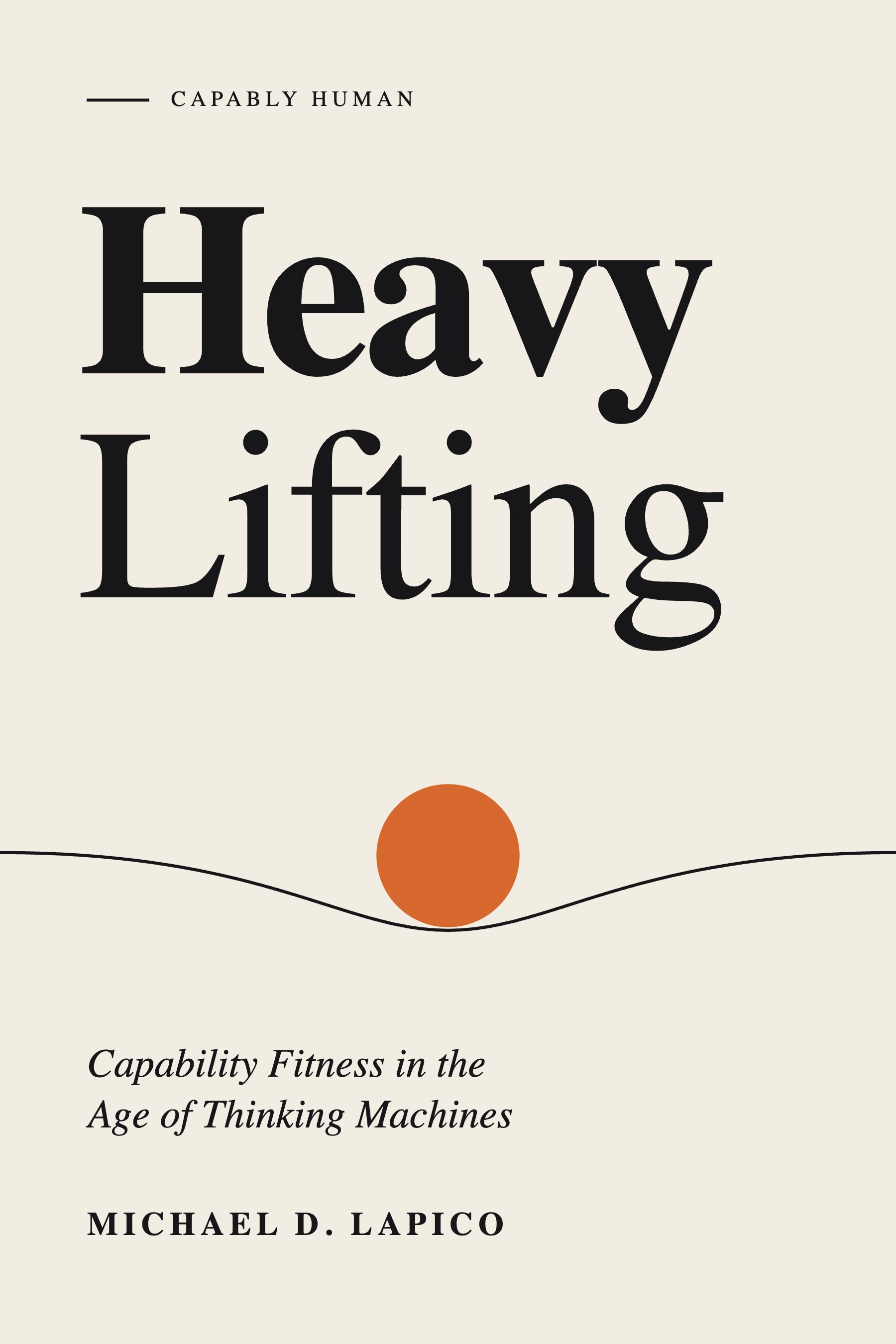
Heavy Lifting
Capability Fitness in the Age of Thinking Machines
Michael D. Lapico
Whether AI builds capability or replaces it is a design choice, and the book shows how to make it. Introduces Capability Fitness through five domains and twenty-six observable skills, argues for AI as spotter, not lifter (helping you lift more than you could alone without lifting the bar for you), and sets out rules of engagement for working with AI.
- AmazonComing soon
Hardcover · Paperback · Kindle
- Apple BooksComing soon
Ebook
Coming soon in hardcover, paperback, and ebook.
About the Book
Who is doing the heavy lifting — you, or the machine?
Your great-grandparents never needed a gym. Their work was the workout. When machines took over the labor of our bodies, nobody gave the machines back. We invented exercise instead, heavy lifting that moves nothing, and got stronger for it.
Now AI is taking the load off thinking, and much faster. It will gladly write the essay, weigh the decision, and dream up the idea. Used one way, it lifts the bar for you: the work gets done, and you skip the reps. Used another, it works like a good spotter, helping you lift more than you could alone while the reps stay yours. Which one you get is a design choice, and it is ours to make.
Michael D. Lapico, a product design leader who spent thirty years making technology effortless, calls the practice we need now Capability Fitness: the lifelong work of building and keeping the capabilities we use to reason and decide, learn, focus, create, and adapt. Heavy Lifting shows how, with rules of engagement for working with AI: what to delegate and what to retain, when to trust and when to challenge, when to let it run and when to step in.
The machines will keep getting better. This book is about making sure we do, too.
Two Men on a Bus
One man sat. The other climbed.
In the years after the Second World War, a British epidemiologist named Jerry Morris became preoccupied with a puzzle. Heart disease seemed to be rising, and nobody could say why.
Every red double-decker bus carried two men, hired by the same employer and working the same shifts in the same city.
Look again at the conductors. They were not exercising. Not one of them climbed those stairs for the good of his heart; he climbed them because that was where the passengers were. His fitness came folded inside an inconvenient job, a benefit nobody had designed and nobody noticed.
Now look at the man in the cab. His disadvantage was just as invisible. No one at London Transport thought of driving as the dangerous job, and in the ordinary sense it wasn’t. The driver did nothing wrong. Something had stopped happening to him. He was being harmed by an absence, which is a hard thing to see and a very easy thing to live with.
From the Introduction · The Conductor and the Driver
The driver
sat in his cab from the start of the shift to the end, hands on the wheel and feet on the pedals
2.7per 1,000 a year
The conductor
worked the aisle and the narrow stairs, up to the top deck to collect fares and down again and up again, climbing, by later accounts, five hundred to seven hundred and fifty steps a day
1.9per 1,000 a year
The New Driver’s Seat
For almost all of human history, our minds have been conductors.
Thinking was built into ordinary life the way climbing was built into the conductor’s shift. That is changing, and faster than most of us have noticed.
Consider an ordinary Tuesday for a knowledge worker. Call her Dana. She is a composite, assembled from people observed at work.
Who did the heavy lifting?
The machineDana
1 · Email
40 overnight emails
AI summarized and drafted; she sent
The machine did the thinking2 · Report
A 20-page report
She read the summary
The machine did the thinking3 · Proposal
Proposal due Friday
AI outline; she edited
Dana editedThe machine did the thinking4 · Decision
Two vendors, one budget
She took the AI’s pick
The machine did the thinking5 · Drive home
Getting home
Turn-by-turn directions
The machine did the thinking6 · Dinner
How does photosynthesis work?
She asked her phone
The machine did the thinking
Stairs climbed: almost none.
Each of those choices was reasonable. Most made her faster, some made her better, and none of them felt like a loss. Count the stairs, though. The emails, the report, the proposal, the vendors, the drive home, the question at dinner: six flights in one ordinary day, and Dana climbed a few steps of one, editing an outline. She was busy from coffee to dinner. She spent the whole day in the driver’s seat.
The Last Time We Lost Our Load
The body did not stop needing load; the world simply stopped providing it.
A society that had lost the effort built into its work learned to put it back on purpose, and it turned an odd new habit into a science, an industry, and a new idea of what it means to be healthy. This book argues that we are at the beginning of the same story for the mind.
1Effort built in
- Body
- Farm, factory, walking
- Mind
- Remembering, calculating, navigating, deciding
2Effort removed
- Body
- Cars, machines, desk work
- Mind
- Search, GPS, AI assistants
3The lag
- Body
- Heart disease; the 1954 fitness gap
- Mind
- A measured risk: skills that slip after brief AI use
we are here
4Deliberate development
- Body
- Exercise, coaching, sports science
- Mind
- Capability Fitness: practice, design, measurement
Its principle is simple enough to fit on an index card:
Technology changes patterns of practice.Patterns of practice influence capability.
Spotter, Not Lifter
The question is not whether we will use intelligent machines. We will, and we should. The question is who is doing the heavy lifting.
The spotter
When you bench-press near your limit, you want a spotter, someone who stands behind the bench, lets you struggle, and touches the bar only enough to keep you safe; with a good spotter you lift more than you could alone, and you get stronger for it.
The lifter
The alternative is a lifter, who takes the bar out of your hands and presses it for you. The weight goes up. You don’t.
Intelligent machines can be either one. The same system that can do our thinking for us could also be the most patient coach in history, a spotter available to every child, every worker, and every aging parent at any hour of the night. Which one we get is not a fact about the technology. It is a decision about design and use, made millions of times a day by the people who build these tools and the people who pick them up.
Chapter 3
Ten minutes
In the spring of 2026, a team of researchers from Carnegie Mellon, Oxford, MIT, and UCLA reported three randomized experiments involving more than a thousand people. The tasks were modest ones, fraction problems and reading passages of the kind found on college entrance exams. Some participants worked with an AI assistant for about ten minutes. Then the assistant was taken away, and everyone carried on alone.
People used the assistant in different ways. About six in ten asked it for direct answers. The rest used it more like a coach, asking for a hint or a clarification or a nudge past the step where they were stuck. Now look inside the assisted group. The losses were concentrated among the answer-seekers, and the people who kept hold of the problem and asked only to get unstuck declined less.
- Never had the assistant
- After ten minutes with it
- Solved on their own · share of the unassisted problems
- 73%Never had the assistant
- 57%After ten minutes with it
- Gave up on a problem · share of the unassisted problems
- 11%Never had the assistant
- 20%After ten minutes with it
That comparison was not randomized, since people chose how to use the tool, and the kind of person who asks for a hint may differ from the kind who asks for the answer. It is the kind of comparison worth running on purpose, with people assigned at random to one way of working or the other, across many more kinds of task. Still, it points at the question this book keeps coming back to. The machine was the same for everyone. What differed was who did the heavy lifting. That is a matter of use, and use can be designed.
The question on the wall
What kind of assistance helps the user complete the present task while becoming more capable of approaching the next one?
From Chapter 14 · Spotter, Not Lifter
Capability Fitness
Five domains of a capable mind
Capability Fitness means building and keeping, on purpose and over a lifetime, the capabilities that let us learn, reason, decide, create, and adapt. The framework sorts the capabilities of the mind into five domains (Think, Learn, Focus, Create, and Adapt) and breaks those into twenty-six specific skills you could watch a person use.
Chapter 6 · Think: The Case That Never Was
Think
Reasoning, problem-solving, and judgment. Most directly at risk when AI supplies conclusions.
Its sub-skills in the Capability Model
- T1Problem Framing
- T2Reasoning & Inference
- T3Evidence Evaluation
- T4Assumption Identification & Testing
- T5Question Formation
- T6Judgment Under Uncertainty
One flight of stairs
Think: frame the problem yourself before you ask anyone, or anything, to solve it.
Ask yourself this week
- Did I frame a problem myself this week before asking a person or a machine to solve it?
- Can I explain the reasoning behind my last important decision, including what I assumed?
- Did I check the evidence behind a claim I relied on?
Practice: before your next prompt, write one sentence that begins “The real problem is…”
Chapter 7 · Learn: The Illusion of Knowing
Learn
Building durable understanding, not just consuming explanation. At risk because fluent input feels like learning.
Its sub-skills in the Capability Model
- L1Comprehension Building
- L2Retention & Retrieval
- L3Application & Transfer
- L4Curiosity & Exploration
- L5Learning Awareness
One flight of stairs
Learn: explain it back, in your own words, before you move on.
Ask yourself this week
- Could I explain the last thing I learned without looking?
- Do I know what I will have forgotten by next month?
- When did I last follow a question past the first answer?
Practice: close the tab, explain it back from memory, then check what you missed.
Chapter 8 · Focus: The One-Keystroke Exit
Focus
Attention, persistence, and self-regulation. At risk because instant response trains intolerance for slow thinking.
Its sub-skills in the Capability Model
- F1Sustained Attention
- F2Distraction Management
- F3Persistence Through Difficulty
- F4Recovery & Re-engagement
- F5Effort Regulation
One flight of stairs
Focus: give a difficulty ten honest minutes before you take the one-keystroke exit.
Ask yourself this week
- How long can I stay with something hard before reaching for help?
- When did I last work for an hour without switching?
- Am I delegating by importance or by convenience?
Practice: a ten-minute attempt window before opening any assistant.
Chapter 9 · Create: Move 37
Create
Generating and developing original ideas. At risk because competent-but-average output is always available.
Its sub-skills in the Capability Model
- C1Idea Generation
- C2Connection-Making
- C3Experimentation & Iteration
- C4Original Voice
- C5Creative Judgment
One flight of stairs
Create: make the first move your own. Generate first; consult second.
Ask yourself this week
- Was the first idea in my last project mine?
- Can I say why a choice in my work is mine and not the default?
- Did I iterate the idea, or only the prompt?
Practice: generate five ideas of your own before asking for any.
Chapter 10 · Adapt: The Skill That Repairs the Others
Adapt
Reflection, revision, and resilience. The meta-domain: it governs whether experience becomes growth.
Its sub-skills in the Capability Model
- A1Reflection
- A2Belief Revision
- A3Strategy Flexibility
- A4Resilience
- A5Feedback Integration
One flight of stairs
Adapt: when something is finished, ask what you would do differently next time.
Ask yourself this week
- What did I learn from my last setback, specifically?
- What belief have I changed recently, and why?
- When did I last ask for feedback I expected not to like?
Practice: run a four-question after-action review at the end of one task this week.
Capability Fitness is not a program you finish. It is a thousand small choices, made daily, about who does the heavy lifting. The questions are from Appendix E, a personal check-in: it is not a test and produces no score.
One scale for every skill
Level 1
Prompted
Performs the skill only when explicitly structured (“What assumptions are you making?”)
Level 2
Guided
Performs it with light cues; misses it without them
Level 3
Independent
Applies it unprompted within practice contexts
Level 4
Transferred
The skill operates outside the practice context, the level that matters
The research behind the book, free from Capably Human
What is Capability Fitness?- Framework · CH-F-001The Capability Fitness FrameworkDefining a New Framework for Human Capability in the Age of Artificial IntelligenceRead it free
- Model · CH-M-001The Capability ModelA Working Model of the Human Capabilities That Matter in an AI-Enabled WorldRead it free
- Tool · CH-T-001The Rules of Engagement CheckA One-Page Tool for Working with AIRead it free
Inside the Book
Seventeen chapters in five parts
It moves from Socrates’ warning about writing to London’s black-cab drivers, from the brain-training industry’s run-in with the Federal Trade Commission to the three and a half minutes that saved US Airways Flight 1549. Every chapter closes with an Open Problem the field has yet to solve, and Chapter 14 introduces the rules of engagement for working with AI (what to delegate and what to keep, when to trust and when to challenge, when to let it run and when to step in), with a one-page version in the Conclusion and a fuller one in Appendix F. Capably Human publishes the rules alongside the book, as a free one-page check, a model and a guide.
Where the chapters begin
Introduction
- The Conductor and the Driver
Part One
The Vanishing Load
Why capability fitness, and why now
- 1The Soft American
- 2Socrates Was Half Right
- 3Ten Minutes
Part Two
The Anatomy of a Capable Mind
The framework and the Capability Model
- 4What the Brain Trainers Got Wrong
- 5Three and a Half Minutes
- 6Think: The Case That Never Was
- 7Learn: The Illusion of Knowing
- 8Focus: The One-Keystroke Exit
- 9Create: Move 37
- 10Adapt: The Skill That Repairs the Others
Part Three
A Lifetime of Capability
How the pressures change from childhood to old age
- 11Nothing Yet to Erode
- 12The Missing Rung
- 13The Long Game
Part Four
Building the Gym
Tools, coaching, and measurement that make people stronger
- 14Spotter, Not Lifter
- 15Ten Thousand Steps
Part Five
The Strengthened Mind
The field, the economy, and the future
- 16The Second Fitness Revolution
- 17Centaurs
Conclusion
- Take the Stairs
Appendices
- A · The Capability Model at a glance
- B · Eight principles of human-strengthening AI
- C · Eight measurement guardrails
- D · Open problems
- E · A personal capability fitness check-in
- F · Rules of engagement
- Glossary
Who It’s For
For anyone who would like to remain the conductor of their own mind
To the people who build tools
You are designing practice, whether you mean to or not, and every default you set becomes a habit in millions of minds.
To the people who fund them
The last fitness revolution began with a behavior and grew into one of the largest consumer economies on earth, and the next one is forming now.
To the people who make rules
Weigh capability development, and not only access and efficiency, in every decision about AI in schools and public services.
To parents and teachers
The struggle is where learning happens, so keep the kitchen-table rules from Chapter 11, attempting before asking and explaining it back, and keep reading with children long after they can read alone.
To the people who lead organizations
Name the expertise your people must keep in active use, and give them manual flying hours to keep it.
To the researchers
The field needs you more than it needs anyone else, because almost everything important about this subject is still unknown.
From the Conclusion · Take the Stairs
Early Readers
Read Heavy Lifting before it’s published
Reviewers, journalists, booksellers, librarians, and educators can request an advance reading copy.

About the Author
Michael D. Lapico
For more than thirty years, Michael D. Lapico built technology meant to make things effortless. As a founder, Chief Product Officer, and design executive, he brought web and mobile products to market, from consumer apps to enterprise platforms, and built the first UX organization at an established enterprise technology company. Then AI made thinking itself optional. Now he is turning human-centered design on a harder question: how to build technology that makes people more capable, not less. He is the Founder and CEO of Capably Human, which he founded to pursue that question. He lives in Windsor, Ontario.
Also by Michael D. Lapico, from Capably Human
- Framework · CH-F-001The Capability Fitness FrameworkDefining a New Framework for Human Capability in the Age of Artificial IntelligenceRead it free
- Model · CH-M-001The Capability ModelA Working Model of the Human Capabilities That Matter in an AI-Enabled WorldRead it free
- Guide · CH-G-001Designing for CapabilityA UX Guide to Building Products That Strengthen Human ThinkingRead it free
- Tool · CH-T-001The Rules of Engagement CheckA One-Page Tool for Working with AIRead it free
- Model · CH-M-002The Rules of Engagement ModelThree Decisions in Any Human-AI InteractionRead it free
- Guide · CH-G-002The Rules of Engagement GuideWorking with AI at Work, at School, and in Later LifeRead it free
The Series
The Capably Human series
- Book 1 · Coming soonHeavy LiftingCapability Fitness in the Age of Thinking MachinesThis book
- Book 2 · In DevelopmentLoad-BearingDesigning AI Products That Keep the Thinking Where It Belongsloadbearingbook.com
Press Kit
For press, booksellers, and event hosts
Cover art, the author’s photo and bios, and the book’s details, free to use in coverage of the book.
Downloads
- Front coverJPG · 1800 × 2700 pxDownload
- Author photoJPG · 1254 × 1254 pxDownload
- One-sheetBook one-sheetPDF · US Letter, 1 pageDownload

Author bios
Short bio (about 45 words)
Michael D. Lapico is the Founder and CEO of Capably Human. A product design leader since 1996, he is the author of The Capability Fitness Framework and Heavy Lifting: Capability Fitness in the Age of Thinking Machines.
Author bio (about 95 words)
For more than thirty years, Michael D. Lapico built technology meant to make things effortless. As a founder, Chief Product Officer, and design executive, he brought web and mobile products to market, from consumer apps to enterprise platforms, and built the first UX organization at an established enterprise technology company. Then AI made thinking itself optional. Now he is turning human-centered design on a harder question: how to build technology that makes people more capable, not less. He is the Founder and CEO of Capably Human, which he founded to pursue that question. He lives in Windsor, Ontario.
Sample interview questions
- What is the difference between a spotter and a lifter, and how can AI help people lift more than they could alone without lifting the bar for them?
- Is this a book against AI?
- You spent thirty years making technology effortless. Why do you see the way people work with AI as a design choice?
- The book sets out three rules of engagement for working with AI: Delegate or Retain, Trust or Challenge, Let it run or Step in. How would a reader use them on an ordinary workday?
- What do Jerry Morris’s London bus conductors have to do with the mind?
- What is Capability Fitness, and what isn’t it?
- In the ten-minute experiments, people who asked the AI for hints declined less than people who asked it for answers. What should readers take from that, and what shouldn’t they?
- Why did brain training fail, and what does that teach anyone trying to strengthen the mind?
- Children are still building these capabilities. How can parents and teachers shape their use of AI so it strengthens them?
- What would you say to the people who design AI products?
- If a reader wants to start this week, which flight of stairs should they take first?
Contact
Interviews, events, and bulk orders
Write to the Capably Human team about the book.
Media & interviews
Interview and podcast requests, excerpts, and review copies for journalists and reviewers.
Speaking & events
Talks and conversations with Michael D. Lapico for conferences, companies, universities, and schools.
Bulk orders
Copies for teams, courses, and reading groups.
Launch Updates
Be the first to know when Heavy Lifting is published
The book is coming soon. Leave your email and we’ll let you know as soon as you can pre-order it, and again on publication day.